


Nomadic living offers a blend of motion and stillness. It’s important to balance movement with rest and reflection.
The new priorities in life are toilets, showers, water and fuel/s. The availability and pleasantness of these will often govern how long you stay in any one place.
If you’re lucky enough to have everything onboard then you’ll be more relaxed about your movements (pun intended!)
You’ll notice that those who stay in one place too long, and also those who move along too quickly never seem happy.
The ratio of stationary days versus moving days is always going to be different depending on where you are, the conditions, and what your intentions are.
When I’m on the move I usually try to drive half a day and stay put for a few days, up to a week or so if the location warrants it.
Of course it always varies depending on whether you get bored or whether you meet anyone to talk to, whether there’s swimming available, etc.
Maybe you have to go to town for food or water, then decide to move right along…
In any case, you don’t want to be driving day after day unless you’ve got your heart set on going somewhere far away, it’s far better to move slowly.
Moving too fast stresses your vehicle and your pocket, and it’s pointless anyway. Where do you have to be, unless maybe you have a job organised or an appointment to attend?
When you first start out, you tend to rush things because that’s what life is usually like. Rushing here there and everywhere to keep the bills paid, etc.
But as you move along, you start to slow down and enjoy this slow new pace, with time to look around and explore. Time to gather your thoughts. To research. To plan.
It doesn’t come easy either.
Our minds are programmed to rush It takes some time to snap out of it You may have noticed on a trip abroad that it takes a few weeks to start to adjust to the local rhythms of the new culture. You know, “island time”, etc.
Well, it’s the same principle here, but it can be even harder to snap out of your familiar ways, because everything seems so… familiar.
It took me months, I think five or six months and a few serious realisations before I began to slow down to a sensible, realistic speed.
Early starts are often good for efficiency, and more comfortable if the weather’s hot.
Early starts usually mean you’ll arrive early wherever you’re going and can find the best parking spot before others begin to arrive.
Moving days might start with checking Wikicamps and Google Maps, checking weather conditions, making a decision about where you’re off to if you haven’t already, then getting your ablutions out of the way.
Maybe you’ll cook a quick breakfast if you’re hungry, or wait till you’re someplace shady and do brunch.
Check everything’s tied down and put away, and check around the vehicle to make sure you haven’t left anything.
Check around you for obstructions such as rocks, ruts, ditches or low-hanging branches before you jump in to drive away.
And head off down the road with a smile on your dial, usually in the opposite direction from whence you came!

If the drive turns out longer than expected then you have the flexibility to stop and camp.
No problem You can get to where you were going tomorrow. No biggy.
Stop every hour or so and have a stretch and a short spell. The larger the vehicle the more important this is If you want have a coffee and a snack.
It’s surprising how much more alert you feel when you resume your drive. I was a full-time driver for years and some of the trips were punishing. What I found was: it’s always a good idea to have a coffee or tea and something light to eat early rather than waiting, and it’s always a good idea to have regular stretch breaks.
Have a bit of a walk around and check your tyres, and that everything else is as it should be. Check for any fluids on the wheels or dripping onto the ground, and for any hissing or leakage from the engine area.
Better to find a fault and fix it, or call for assistance sooner than later. It’s nearly always cheaper to fix, and will help avoid something more serious happening.
I’ll leave that to your imagination.
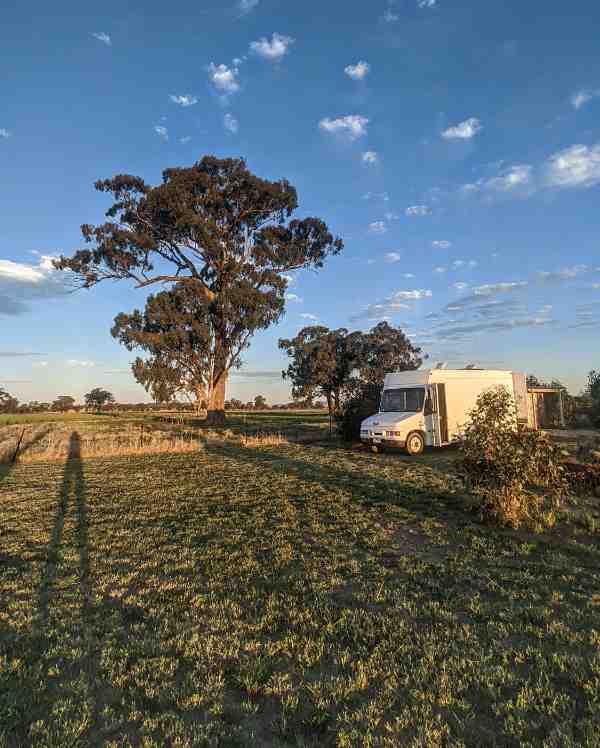
“There was nowhere to go but everywhere, so just keep on rolling under the stars.”
– Jack Kerouac
Any comments, contributions, thoughts or insights?
We’d love to hear from you.
I usually try to limit it to between 2 and 4 hours driving with the aim of arriving at my chosen destination early, get set up in a good spot, and have a good look around before happy hour, preparing dinner, or whatever’s your pleasure.
Always, always try to enjoy the sunset. It’s your advantage over the many millions who can’t, and great way to reward yourself for being so bold!
Prepare your playlists or chosen entertainment in advance.
It makes for a better drive if you’ve already prepared playlists or podcasts.
It sucks fumbling around for your desired music while you’re trying to drive.
Get it together before you leave.
Always be sure to mentally map where you will get water, and where you’ll get fuel.
It’s an awful feeling if you forget to be aware of your fuel situation and you’re in the middle of nowhere and the fuel gauge says “empty”.
In Australia this can be deadly dangerous, depending on weather extremes and where you are. Don’t let it happen to you.
Take the scenic route!
Research the maps the day before you leave and find scenic routes. They are one major difference between dull pleb life and awesome nomad life!
Take time and stop at interesting places.
You may never pass this way again!
A simple diary is really worthwhile. You can make brief notes of where you went, what you saw, who you met, and these are a source of immense pleasure when you read them in the future.
It’s amazing how much you forget if you don’t write it down I sound like your mother now! Haha!
Always cruise through very slowly. Think about how much it pisses you off when others kick up dust when you’ve just finished cleaning everything.
The other thing is that it’s often rough and unless you’re very careful you’ll shake up all your stuff and have things fall down.
My best tip is to have a bike and explore the whole site on that. You can find the best spots on a bike much easier.
It also gives you an opportunity to sum up the antics of the neighbours and how noisy or inebriated they might be.
Try and find a fairly level spot as close to the water source as you can.
Some people like to park close to the toilet block if there is one. I’m not one of them. A reasonable distance is okay but I can think of many things I’d rather park close to.
Be aware of heavy tree limbs that could snap and fall on you at any time. They don’t warn you. They drop far more often than many people realise.
Also always check for snakes. Amazing how many more snakes you see when you’re on the road all the time.
Once you’ve chosen a spot and set up camp your time is yours.
Kick back and reflect on your day and make plans for your next drive or whatever you feel like doing.
“Nothing behind me, everything ahead of me, as is ever so on the road.”
– Jack Kerouac
Any comments, contributions, thoughts or insights?
We’d love to hear from you.
Enjoy a slower start and savour the morning.
If you’re up early enjoy the sunrise and the local bird life.
Take a chair and maybe your phone or a book to a tree beside a creek or a lake or some other feature and enjoy a coffee there.
One thing I don’t understand is why such an enormous percentage of people restrict themselves to sitting under their annex.
Why? You have nature now.
There a few things more pleasant than sitting under a shady tree.
Early is a great time for writing, exercise or meditation.
Organise laundry, do vehicle checks, or organise your living space.
Restock your supplies: browse local markets or farm stands.
Deeper cleaning and minor repairs.
Catch up on remote work, writing, or content creation.
Explore creative hobbies like photography, music, or whatever you do.
Hike, swim, or visit local cultural spots. Take photos.
Connect with nature – read under a tree, stargaze at night.
Talk to other travellers and share stories.
Check out local events or connect online with nomad groups.
Enjoy campfire conversations or solo reflection.
Prepare for the next phase of your adventure. Dream!

Life is yours. Waste no time.
Office : The Chariot
Address: Roads of Australia

About Life Unmapped
Hey, I’m Marley, the traveller behind Life Unmapped – a seedling of ideas for anyone considering other ways to make life work.
There’s tips and inspiration for people struggling with the cost of living, and for those craving more from life.
It’s still a young blog and I’ll add to it whenever articles are completed.
Please call back often and enjoy new content.
Skill set:
Do you have a story? Let’s chat.
“It is not the strength of the body that counts, but the strength of the spirit.” – J.R.R. Tolkien
Privacy
Terms
Attributions
Disclosure
Some links on here are referral links, which means I may earn a small commission if you make a purchase through them – at no extra cost to you.
These are only products & services I have personally used, or those trusted friends have shown & recommended to me and I truly believe to be great items.
Thanks for supporting Life Unmapped! 😊
Travel Gear and Stuff
Budget-Friendly Travel Gear
Must-Read Books on Simple Living
Top Tools for Digital Nomads
Please!

Quick links:
Start Here About Me
Nomadic Living Tips
Self-Sufficiency Hacks
Copyright © 2024-5 *Life Unmapped*
(All Rights Reserved).
F*CK plastic waste – drink tap water!